How to prevent build-up of limescale in the washing machine?
Issue
- How to prevent build-up of limescale in the washing machine?
- Descaling the washing machine
Applies to
- washing machine (integrated and freestanding)
- washer-dryer
Resolution
Why Limescale Is a Problem
When the heating element becomes coated with limescale, it can cause several issues:
- Slower heating times – water takes longer to reach the desired temperature
- Shortened lifespan of components – especially the heating element
- Risk of breakdown – the heating element may fail completely
- Potential damage to bearings – leading to costly repairs
How to Remove and Prevent Limescale
1. Descale Your Washing Machine Regularly
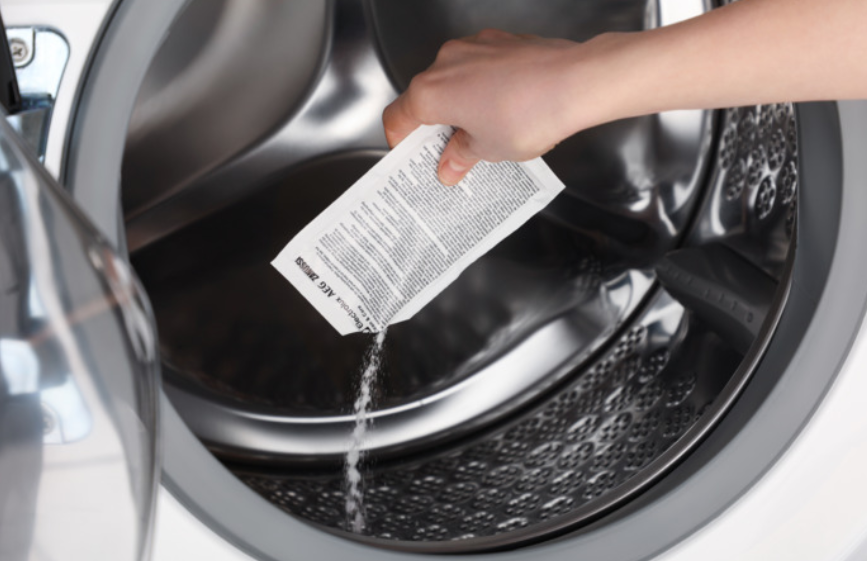
For optimal performance, use a dedicated descaling product to remove existing limescale deposits. Regular descaling helps maintain efficiency and prolongs the life of your appliance.
Follow the instructions provided with the descaler
We recommend specialized detergents available on our Webshop.
2. Understand Your Water Hardness
Limescale is caused by minerals found in hard water. The harder the water, the more deposits can form.
- Water hardness levels can vary even within the same region
- Supply sources may change depending on local demand
- Contact your water supplier or local authority to check your area’s water hardness (°dH level)
3. Set a Descaling Schedule
How often you should descale depends on:
- Water hardness level
- Frequency of wash cycles
As a general guideline:
- In hard water areas, descale more frequently
- In softer water areas, less frequent descaling may be sufficient
Refer to your appliance manual or descaling product guidelines for a recommended schedule based on your local water hardness.
See the table for detailed guidance
Descaling frequency | ||||||
Hardness in °F | Hardness in °e, °Clark | Hardness in °dH | Specifications for water hardness | < 2 wash cycles/day | 2-4 wash cycles/day |
|
0-7 | 0-5 | 0-4 | Extremely soft | - | - | - |
7-14 | 5-10 | 4-8 | Soft | - | - | Once a year |
14-21 | 10-15 | 8-12 | Medium-hard | Every 6 months | Every 6 months | Every 6 months |
21-32 | 15-22 | 12-18 | Fairly hard | Every 6 months | Every 3 months | Every 3 months |
> 32 | > 22 | > 18 | Hard | Every 3 months | Every 2 months | Every month |
Still need help? Get expert support
If the issue continues, a professional technician can help diagnose and fix the problem.
No matter if your appliance is in warranty, out of warranty, or covered by an appliance protection plan - we’ll guide you to the right service.
Was this article helpful?
Related Articles
- Washing machine displays error message EF0, EFo, EF3 or emits 15 beeps / 15 flashes
- Washing Machine Displays Error Code E90, E91, E92, E93 or E94
- Washing machine does not take detergents / water remains in the fabric softener compartment
- How to change the temperature in the ECO 40-60° program?
- How to use the steam programmes on your Electrolux washing machine or washer dryer
- Washing Machine Not Working or Not Turning On – Troubleshooting Guide
- The washing machine door does not close properly
- Washing machine stops in the middle of a cycle
- The "drum cleaning" icon appears on the washing machine display
- Removing and cleaning a washing machine detergent dispenser drawer
Spare parts & Accessories
Find original spare parts for your appliance in our webshop and have them delivered directly to your door.
Related Articles
- Washing machine displays error message EF0, EFo, EF3 or emits 15 beeps / 15 flashes
- Washing Machine Displays Error Code E90, E91, E92, E93 or E94
- Washing machine does not take detergents / water remains in the fabric softener compartment
- How to change the temperature in the ECO 40-60° program?
- How to use the steam programmes on your Electrolux washing machine or washer dryer
- Washing Machine Not Working or Not Turning On – Troubleshooting Guide
- The washing machine door does not close properly
- Washing machine stops in the middle of a cycle
- The "drum cleaning" icon appears on the washing machine display
- Removing and cleaning a washing machine detergent dispenser drawer